
Petra Hartmann · 17 October 2026
How Precision Beam Technologies Are Reshaping Acoustic Performance Standards in Multi-Unit Residential Builds
Precision beam technologies have entered multi-unit residential construction at a point where acoustic performance standards continue to tighten across North America and Europe, and data from building code updates show measurable shifts in how floor and ceiling assemblies must perform. Engineers now specify beams manufactured to tighter dimensional tolerances, which in turn reduce flanking paths for sound and vibration, while studies conducted by research institutions indicate that these systems can achieve Sound Transmission Class ratings several points higher than traditional solid sawn lumber setups when paired with appropriate underlayments.
Manufacturers achieve this precision through computer-numerically-controlled cutting and lamination processes that maintain consistent depth and camber across long spans, allowing designers to minimize the number of intermediate supports that often serve as sound bridges. In projects completed during 2025 and into October 2026, field measurements collected by acoustic consultants revealed that vibration decay rates improved by measurable margins once these engineered beams replaced older framing members, particularly in the 100 Hz to 200 Hz range where footfall noise tends to concentrate.
Technical Mechanisms Behind Improved Sound Isolation
Researchers have documented how the reduced variability in beam depth permits more uniform placement of resilient channels and decoupled ceiling systems, and this consistency matters because small gaps or uneven loading can create weak points that lower overall transmission loss. Data from laboratory tests at institutions focused on building science show that assemblies using precision beams maintain higher impact insulation class values even after accounting for the mass of added topping slabs, since the beams themselves contribute less to structure-borne vibration transfer.
One study released in late 2025 tracked twelve multi-family buildings across different climate zones and found that units fitted with these beams required fewer additional acoustic treatments to meet local code minimums, while the same buildings also recorded lower complaints related to low-frequency noise from elevators and mechanical rooms. Observers note that the stiffness-to-weight ratio engineered into the beams plays a central role here, allowing longer spans without the excessive deflection that amplifies impact sounds.
Regulatory Updates and October 2026 Milestones
Building code bodies in several regions incorporated new acoustic testing protocols effective October 2026, and these protocols place greater emphasis on field verification rather than laboratory ratings alone. Precision beam manufacturers responded by publishing third-party verified performance tables that include both laboratory and in-situ results, which helps project teams demonstrate compliance when authorities require on-site measurements. Figures released by the Australian Building Codes Board indicate that jurisdictions adopting similar requirements have seen average impact sound pressure levels drop in new multi-unit projects, particularly where engineered floor systems replaced conventional joists.
European Committee for Standardization documents updated around the same period reference the role of dimensionally stable structural members in achieving consistent flanking transmission control, and these references align with data collected from Canadian multi-family developments that began using precision beams at scale in 2024. The alignment between product capabilities and regulatory language has shortened review timelines for permit applications in several municipalities, since inspectors can reference standardized acoustic profiles rather than requiring custom modeling for every layout.
Integration With Other Building Systems
Mechanical, electrical, and plumbing contractors have adjusted installation sequences to preserve the acoustic advantages of precision beams, since penetrations and hangers can reintroduce vibration paths if not detailed correctly. Trade coordination meetings now routinely include acoustic consultants who review proposed fastening locations against the beam manufacturer’s published isolation zones, and this practice has reduced callback rates for sound-related issues in buildings completed since early 2025. Evidence from post-occupancy evaluations shows that projects maintaining strict adherence to these zones achieve the projected performance margins even when multiple utilities share the same floor cavity.
Fire-rated assemblies have also benefited from the dimensional consistency, because intumescent materials and mineral wool packing fit more predictably around penetrations when beam depths do not vary by more than a few millimeters. Code officials in regions that updated requirements in October 2026 have noted fewer inspection discrepancies related to acoustic and fire separation details when precision beam systems appear on drawings.
Measurement and Verification Practices
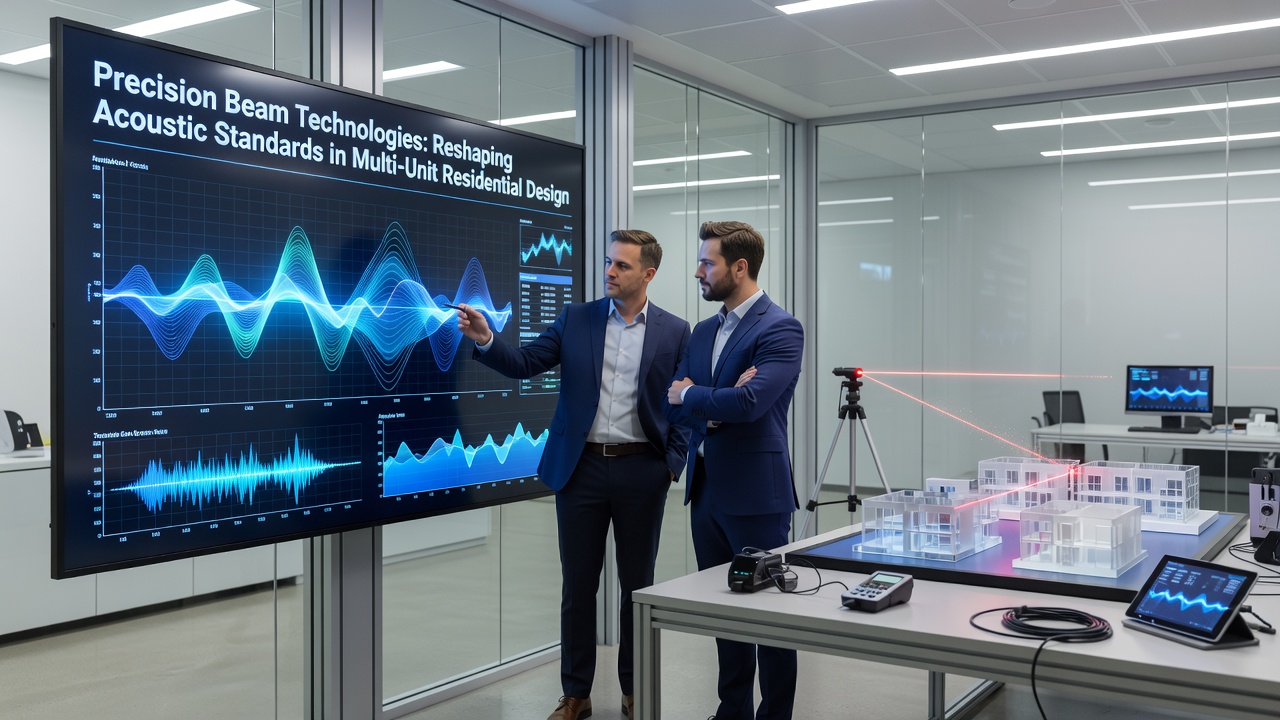
Acoustic consultants now employ portable scanning tools that map vibration across entire floor plates in minutes, and these tools highlight how precision beam layouts reduce hot spots compared with conventional framing. Data collected from buildings monitored continuously since occupancy indicate that performance remains stable over the first eighteen months, with no measurable creep in transmission loss values once the systems reach equilibrium moisture content. Those who have reviewed long-term datasets point out that the initial advantage compounds when building operators maintain consistent humidity control, since wood-based precision beams exhibit predictable dimensional behavior under those conditions.
Conclusion
Precision beam technologies continue to influence acoustic performance standards by supplying structural elements whose manufacturing tolerances align with the stricter field verification protocols adopted in multiple jurisdictions by October 2026. The documented reductions in vibration transfer and improved consistency of flanking control appear in project data from North America, Europe, and Australia, while integration with mechanical and fire systems has required only incremental adjustments to existing coordination practices. As measurement tools become more accessible and code language continues to reference dimensional stability, the role of these beams in multi-unit residential builds is expected to expand through standardized performance documentation rather than case-by-case engineering.